The Full Story Behind PureSlate
Some things earn a second thought. A cutting board has never been one of them.
You probably bought yours without thinking much about it, and you've used it almost daily since — without ever asking what it's made of, or what happens to it every time a blade crosses it. If you just read about why a former health inspector switched theirs, here's the complete case, start to finish.
What's actually happening on a plastic board
Every cut leaves a groove. Those fine white lines that build up on an old plastic board over the years aren't just cosmetic wear — they're the surface losing material, a little at a time, with every single use.
In 2023, researchers publishing in the American Chemical Society's Environmental Science & Technology set out to measure exactly what happens to that lost material. What they found: ordinary knife use on plastic cutting boards releases microplastic particles directly into whatever's being prepared on them. That finding has since been repeated and expanded on, including in a 2025 review published in the Journal of the Academy of Nutrition and Dietetics.
What we actually know — and don't
We want to be straightforward about what that research does, and doesn't, tell us. The FDA has reviewed the broader question of microplastics in food and currently states that "the scientific evidence does not demonstrate that the levels of microplastics or nanoplastics detected in foods pose a risk to human health." That's the honest, current answer. The long-term health science isn't settled, and we're not going to tell you otherwise just to make a better case.
Here's what doesn't require waiting for that science to settle, though: a cutting board with no plastic in its surface has no plastic to shed. Not less. None — because the exposure pathway itself doesn't exist. Whatever the research eventually concludes, avoiding a real, measurable pathway costs nothing to do now.
Plastic isn't the only material with an asterisk
Wood has its own — porous by nature, which is exactly why it needs regular oiling to keep from cracking, and exactly why USDA's Food Safety and Inspection Service specifically recommends a nonporous surface for handling raw meat and poultry, along with using a separate board for raw protein versus produce. That's not a marketing claim. It's published federal food-safety guidance, and it's the reason most professional kitchens don't rely on wood or plastic boards for their raw-protein stations at all.
Why we built it this way
So the real question we started asking wasn't "which material is dangerous" — nobody can honestly answer that yet, for plastic or for anything else. It was: which material has the fewest open questions?
One that can't shed into food, because it isn't made of anything that sheds. One that meets the surface type food-safety guidance already recommends for raw protein. One that doesn't need oil, doesn't crack, and doesn't ask you to just trust that it's fine.
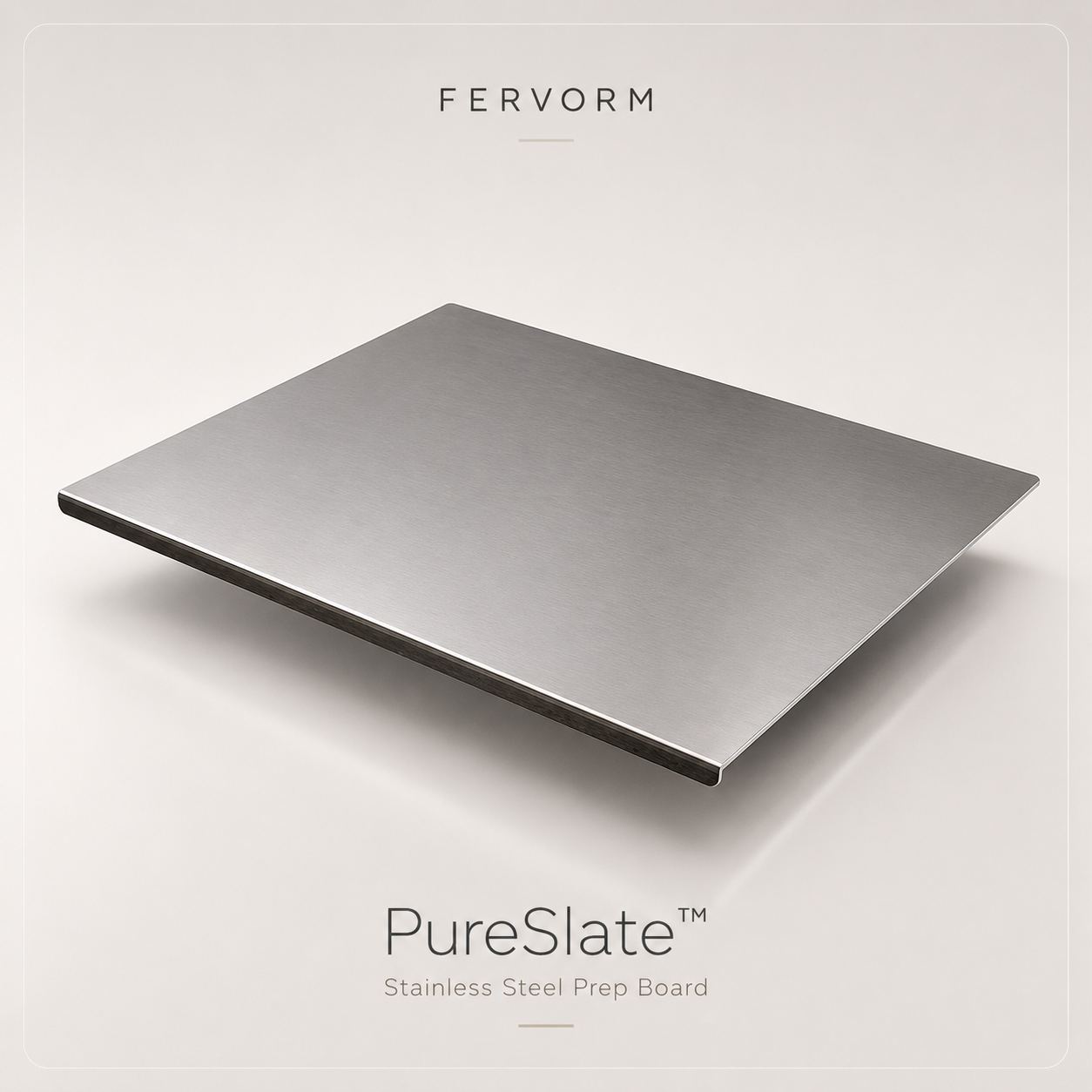
That's PureSlate: a single, continuous piece of stainless steel — the same non-porous, professional-grade material used in commercial kitchens — with a 90° edge that locks onto your counter instead of sliding on it. No seams, no plastic in the surface, nothing to wear away, and nothing that requires you to take our word for any of it.
See PureSlate One piece of stainless steel. Nothing to shed, nothing to hide behind.